Kulla destruction
Gate CrashersKulla destruction is a planetary geocide whose significance extends far beyond the loss of one world. It becomes the central physical fact in a dispute over jurisdiction, guilt, and the political power to define history: the Assembly treats the destruction of Culpus-Alam, Okim, and Kulla as grounds for punishing humanity, while D’armic’s investigation establishes that the human vessel Bucephalus could not have produced the portals required to annihilate them. The catastrophe therefore functions both as an apocalypse and as evidence in a larger struggle over colonial control, institutional secrecy, and the consequences of technological violence.
Causes and Historical Background
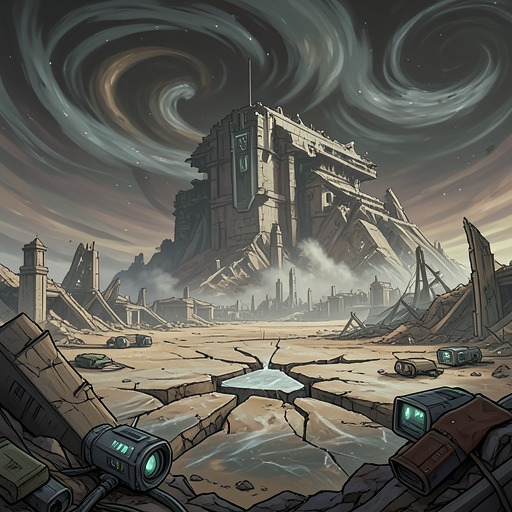
The method behind Kulla’s destruction belongs to the Lividite war against the Pu’Lan and, by implication, against nearly every opposing power. In the closing phase of that war, the Lividite military had overextended itself after the Pu’Lan inflicted the first defeats in its campaigns among the stars. Seeking to restore its initiative and make an example of the Pu’Lan, the military adopted a form of planetary destruction that required neither prolonged occupation nor conventional bombardment. A ship could fly directly at a world, open a high-space portal, and let the breach bore a tunnel through the planet.
The consequences were not limited to a surface attack. Collapse of the magma tunnel triggered two immense volcanoes at the entry and exit wounds, shattered tectonic plates, disrupted the planetary core and magnetic field, and ruined the surface in an apocalypse. Kulla thus belongs to a known historical technology of geocide rather than to an inexplicable natural disaster. Its destruction carries the memory of an older civilization’s willingness to convert strategic desperation into planetary annihilation.
The Catastrophe and Its Scale
The novel presents planetary destruction through images that make cosmic violence almost physically imaginable. When D’armic encounters a titanic worm of fire twisting through the vacuum, its boiling skin throws off fragments larger than his cutter and its glowing maw resembles a monster from the oldest forgotten superstitions of his people. His lower brain responds before rational understanding can intervene, opening a portal and sending the cutter back to the universe below. The encounter initially appears impossible because the phenomenon seems mythic rather than technological.
D’armic’s sensor records transform that nightmare into measurable evidence. The fire worm’s estimated mass matches, to six decimal places, the mass missing from Culpus-Alam. The discovery confirms that the monster was not a creature rising from imagination but the material consequence of planetary destruction. Although the available evidence discusses Culpus-Alam directly and places Kulla within the same class of destruction, the later legal argument identifies Kulla as one of the worlds destroyed by portals of the same impossible scale.
The narrative repeatedly contrasts the magnitude of such destruction with ordinary human perception. Felix witnesses a gargantuan red-hot inverted cone rising beyond the horizon like a crimson mountain balanced on its summit, so immense that his field of vision can scarcely contain it. Elsewhere, Allison lies awake after firefights, captivity, the threat of torture, and witnessing a planet’s death, while the unresolved possibility of Earth’s destruction becomes the immediate cause of her insomnia. These scenes place Kulla’s significance within a wider disaster pattern: planetary violence is both incomprehensibly large and experienced through frightened bodies, sleeplessness, and failing attempts at emotional control.
Misattribution and Political Consequences
Kulla destruction is used against humanity because the Assembly believes the newly spacefaring humans are responsible for the planetary geocides. During the hearing, the human representatives are treated as prisoners suspected in the destruction of Solonis B, the human name for Culpus-Alam. The dispute is not merely semantic. Because Culpus-Alam was classified as an Assembly world, the Assembly asserts jurisdiction over the crime and denies that humans possess authority in the matter, even though the planet housed humans descended from Earth.
D’armic challenges the accusation with a technical distinction that changes the case. Bucephalus is physically incapable of creating high-space portals large enough to destroy Culpus-Alam, Okim, and Kulla. By contrast, the patrol cruiser commanded by the deceased Vel Noric possessed the relevant capability. D’armic’s conclusion implicates Vel Noric and threatens the institutions that accepted the human explanation. Ruckk rejects the idea that a Vel could have ordered geocide, but D’armic answers that disbelief cannot alter physical truth and suggests that those resisting the evidence have an incentive to suppress what the Assembly might hear.
The political danger is intensified by administrative delay. Bloon reports that the Xecoron will soon arrive at Earth and that other ships are scheduled to reach human colony worlds simultaneously to enforce sequestration. The retaliatory strike against Earth has already been launched before the rescuers can prevent it, and the strike is described as imminent. Kulla therefore becomes part of a chain in which a destroyed planet produces an accusation, the accusation authorizes collective punishment, and institutional hesitation allows retaliation to proceed even after the original case begins to collapse.
Human Experiment and Colonial Gaze
The history surrounding Kulla is inseparable from the Assembly’s treatment of human populations as objects of study. Culpus-Alam was established generations earlier as an anthropological experiment intended to model how humans might react when encountering unfamiliar cultures. Human groups were transported from Earth: isolated tribes were preferred as base populations, while random sampling was added to reduce the risks of inbreeding. The people living there consequently possessed real cultures and histories, but the Assembly’s framework reduced them to experimental material in a controlled setting.
The first encounter with one of these populations reveals the contradiction at the heart of that arrangement. A short, nearly unclothed woman emerges from foliage with a blowgun and blue-and-white body paint, yet beneath the superficial differences she is unmistakably human. The investigators are not encountering an alien species but displaced human descendants whose appearance has been shaped by isolation and local culture. Allison’s attempt to obtain information through a map also shows the limits of the supposed experiment: the mother cannot identify the location herself but says that Tolo can, while warning that the tribe’s men are not warriors or heroes.
Vel Noric’s observation confirms the institutional logic behind the planet. He watches human vessels leave through high-space and regards Culpus-Alam as a world set aside by the civilized galaxy to observe humans in a controlled environment. The experiment has run unattended for many cycles, allowing distinct tribal cultures to develop before the Assembly’s planned next step of facilitating contact and observing their interactions. Its scientific language conceals a colonial structure: the Assembly chooses the populations, names the world, controls access, and claims authority over the consequences while the observed people have no meaningful say in the experiment.
Significance in the Novel
Kulla destruction exposes the instability of every category used to govern the interstellar conflict. Humans are simultaneously treated as dangerous newcomers, as experimental subjects, and as a population incapable of possessing jurisdiction over a world inhabited by their own kind. The Assembly’s explanation of humanity is itself contradictory: its broadcasts show humans cooperating with other races in some accounts and destroying one another in others. The experiment was created because the observers could not decide whether humans were noble and tolerant or irrational, violent, and bigoted; the human representatives recognize that both versions can be true.
The event also gives technological progress an ominous double edge. Humanity’s breakthrough beyond the light barrier makes interstellar contact possible, but it also places humans inside a political system where planetary weapons, sequestration, and retaliatory fleets can operate across impossible distances. The Assembly argues that human colonies were once too remote for war to be logistically practical and asks how long it will be before humans begin killing one another again. Allison answers with faith in a common cause, yet the surrounding crisis undermines that optimism: knowledge of other sentient species does not automatically abolish conflict, and a mistaken judgment can become a planetary threat before diplomacy catches up.
Finally, Kulla’s destruction is part of the novel’s recurring contrast between catastrophe and procedural or comic human behavior. A civilization can discuss geocide in hearings, calculate portal capacities to six decimal places, and still fail to recall an armada in time. Later, determined operators disable every fail-safe on Unicycle before releasing a 32.4-terawatt particle beam against the Xecoron, demonstrating that safeguards can prevent mishaps but cannot stop deliberate action. Kulla thus remains both a dead world and a warning: the most terrifying disasters arise when immense technical capability is joined to military desperation, institutional denial, and the confidence that someone else will bear the consequences.